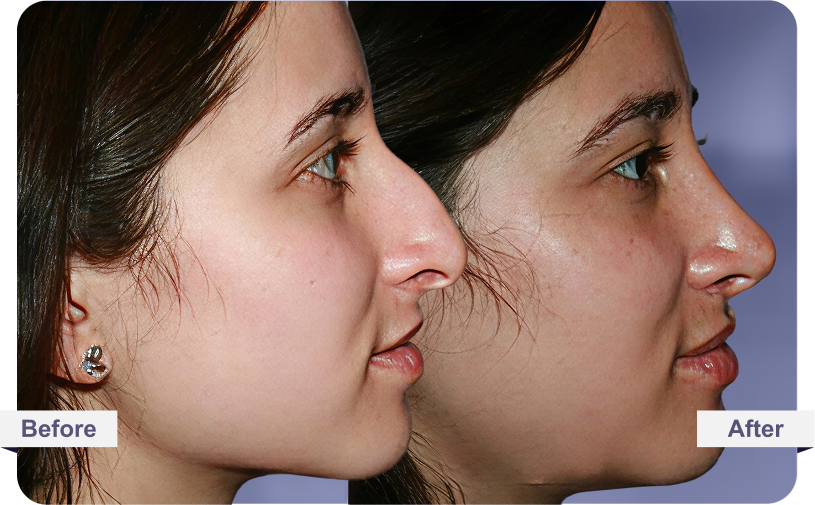
If you’ve ever taken a close-up selfie, stood under bright bathroom lighting, or studied old photos side by side, you may have noticed something that catches you off guard: your nose doesn’t look quite the same on the left as it does on the right. One nostril might look bigger. The bridge might lean slightly to one side. The tip might appear to point in a different direction depending on the angle.
If this sounds familiar, take a breath you are far from alone. This is one of the most common concerns patients bring to our Washington DC and Chevy Chase, Maryland office, and in almost every case, there’s a simple explanation.
Your Face Was Never Perfectly Symmetrical And That’s Normal
Here’s something most people don’t realize: no human face is perfectly symmetrical. Not yours, not a supermodel’s, not anyone’s. Research on facial anatomy has consistently shown that the left and right sides of the face differ in subtle ways bone structure, cartilage growth, muscle development, and even the size of the eyes and ears.
The nose sits directly in the center of the face, which paradoxically makes it the feature most likely to reveal this natural asymmetry. Because it’s a three-dimensional structure made of bone, cartilage, and soft tissue, even a tiny difference between the two sides becomes visible when you look closely.
Common Reasons Your Nose Looks Different From Each Side
- Natural Growth Asymmetry As your facial skeleton develops throughout childhood and adolescence, the cartilage and bone on each side of the nose rarely grow at the exact same rate. This is simply part of normal human development not a flaw, and not something you did wrong.
- A Deviated Septum The septum is the wall of cartilage and bone that divides your nostrils. In many people, it doesn’t sit perfectly in the center. A deviated septum can make one nostril appear smaller, shift the visible angle of the bridge, and in some cases, contribute to breathing difficulty on one side. This is one of the most frequent causes of nasal asymmetry we evaluate.
- A Crooked Nasal Bridge The bony bridge of the nose can curve subtly to the left or right, especially if there’s a family history of it or a past injury even a minor one from childhood that you may not remember.
- Uneven Nasal Tip Cartilage The tip of the nose is shaped by two small pieces of cartilage called the lower lateral cartilages. When these two pieces differ slightly in size, shape, or position, the tip can look twisted, bulbous on one side, or pointed in a different direction than the rest of the nose.
- Old Trauma or a Previous Break Even a nasal fracture from years ago a sports injury, a fall, a bump as a kid can heal in a way that leaves subtle asymmetry, even if you never noticed a change at the time.
- Camera Angle, Lighting, and Perspective Before assuming something is “wrong,” it’s worth remembering that phone cameras (especially selfie cameras) distort proportions depending on distance and angle. Lighting from one side can also create shadows that exaggerate asymmetry that isn’t actually there. This is why, in the office, we always evaluate the nose in person and with computer imaging rather than relying on photos alone.
When Is Nasal Asymmetry Something to Address?
Mild asymmetry is universal and often invisible to everyone but you. But for some patients, the difference is noticeable enough or functionally significant enough to want a solution. Common motivations we hear from patients in the DC Metro area include:
- Feeling self-conscious in photos or on video calls
- A visibly crooked bridge or twisted tip
- Breathing difficulty on one side (often linked to a deviated septum)
- Asymmetry that became more pronounced after an injury
- A previous rhinoplasty that left the nose uneven
If any of these sound familiar, a consultation with a board-certified plastic surgeon is the best next step to understand your options.
How Rhinoplasty Can Correct Nasal Asymmetry
The good news is that nasal asymmetry is one of the most well-studied and correctable concerns in facial plastic surgery. Dr. Philip S. Schoenfeld offers several approaches depending on what’s driving the unevenness:
- Rhinoplasty Comprehensive reshaping of the bone and cartilage to balance both sides of the nose, correct a crooked bridge, and refine overall proportion.
- Nose Tip Plasty A more targeted procedure focused specifically on reshaping and balancing the nasal tip cartilage, ideal for patients whose main concern is the tip rather than the entire nose.
- Functional Rhinoplasty Designed for patients whose asymmetry is linked to a deviated septum or breathing trouble, combining cosmetic refinement with improved airflow.
- Non-Surgical Rhinoplasty For patients with mild asymmetry who aren’t ready for surgery, carefully placed filler can sometimes visually balance minor irregularities in the bridge or tip.
Every nose is different, which is why Dr. Schoenfeld begins with a full facial analysis before recommending an approach. You can learn more about his background and approach to nose surgery on our dedicated rhinoplasty resource page, or read more about Dr. Schoenfeld’s training and experience as a board-certified plastic surgeon.
According to the American Society of Plastic Surgeons, rhinoplasty consistently ranks among the most commonly performed facial cosmetic procedures in the United States, in part because so many patients seek both aesthetic balance and improved nasal function in a single surgery.
What to Expect at a Rhinoplasty Consultation in Washington DC
At your consultation, Dr. Schoenfeld will:
- Examine the internal and external structure of your nose
- Discuss whether your asymmetry is primarily cosmetic, functional, or both
- Use computer imaging to help you visualize potential results
- Walk you through whether surgical rhinoplasty, tip plasty, functional rhinoplasty, or a non-surgical option is the best fit
- Answer every question about recovery, cost, and timeline for your lifestyle
You’re welcome to review before-and-after rhinoplasty results from real patients, or book your consultation online directly with our Washington DC or Chevy Chase office.
Frequently Asked Questions
Is it normal for my nose to look different on each side?
Yes. Almost everyone has some degree of natural facial and nasal asymmetry. It’s only worth addressing if it bothers you cosmetically or affects your breathing.
How do I know if I need rhinoplasty or if my nose is just naturally asymmetrical?
The best way to know is an in-person evaluation. Dr. Schoenfeld can assess whether your asymmetry is within a normal range or related to a structural issue like a deviated septum, and recommend rhinoplasty only if it will genuinely improve your appearance or breathing.
Can rhinoplasty make my nose perfectly symmetrical?
Rhinoplasty can significantly improve balance and reduce visible asymmetry, but no surgeon can promise mathematically perfect symmetry because no natural nose is perfectly symmetrical, even after surgery. The goal is a nose that looks natural, balanced, and proportionate to your face.
I live in Maryland do I have to travel to DC for my consultation?
No. Dr. Schoenfeld sees patients from Washington DC, Chevy Chase, Bethesda, Silver Spring, and throughout Maryland at our Chevy Chase office, which is easily accessible from the DC Metro area.
Will insurance cover rhinoplasty for a crooked nose?
If your asymmetry is linked to a functional issue like a deviated septum that affects breathing, part of your procedure may be considered functional rhinoplasty and could be eligible for insurance coverage. Cosmetic refinement is typically not covered. We’ll help you understand what applies to your case during your consultation.
How long does it take to see final results after rhinoplasty?
Initial swelling subsides over the first few weeks, but it can take up to a full year for all subtle swelling to resolve and for the nose to reveal its final, refined shape especially at the tip.
I only want my nasal tip fixed, not my whole nose. Is that possible?
Yes. If your main concern is an uneven, bulbous, or twisted tip rather than the bridge or overall nose shape, nose tip plasty is often a more targeted, less invasive solution than full rhinoplasty.
Can non-surgical options fix a crooked nose?
Non-surgical rhinoplasty using dermal filler can sometimes camouflage mild asymmetry by adding volume to balance the profile, but it cannot reshape or straighten underlying bone and cartilage the way surgical rhinoplasty can.
How do I choose the right rhinoplasty surgeon in Washington DC?
Look for a board-certified plastic surgeon (F.A.C.S.) with extensive rhinoplasty-specific experience, a strong before-and-after portfolio, and a consultation process that includes computer imaging and an honest discussion of what surgery can and cannot achieve for your unique nose.