
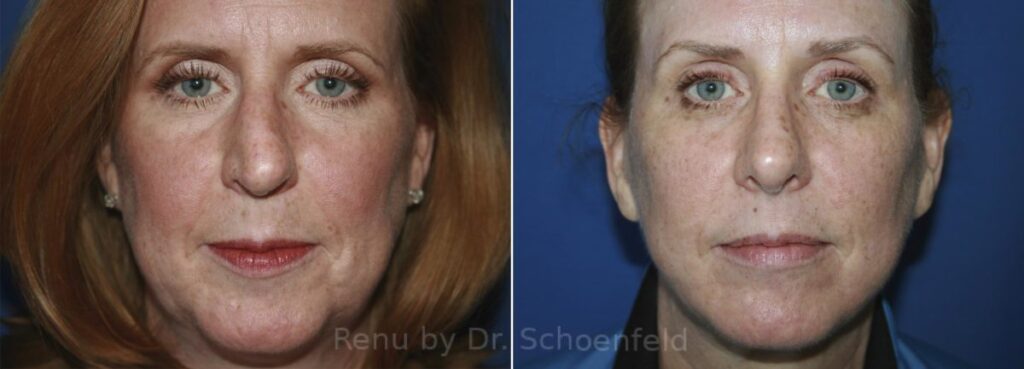
Medically reviewed by Dr. Philip S. Schoenfeld, F.A.C.S., RENU DC, Chevy Chase, Maryland
If you are researching a facelift, you have probably noticed that two names come up again and again: the traditional facelift and the deep plane facelift. Both are forms of rhytidectomy, and both can soften jowls, restore definition along the jawline and give the lower face a fresher look. The difference lies in how deeply the surgeon works, how the tissues are repositioned and how natural the result looks and feels over time.
This guide explains both techniques in plain language so you can walk into a consultation knowing what to ask. It is written for patients across Washington DC and Maryland who want honest information before choosing among their facelift options.
The Short Answer
A traditional facelift (often called a SMAS facelift) tightens the deeper support layer of the face and then redrapes the skin. A deep plane facelift releases and lifts the skin and the deeper tissue together as one unit, which allows the surgeon to reposition the midface, jawline and neck with less tension on the skin. Many surgeons favor the deep plane approach for moderate to advanced aging, while a traditional SMAS technique can still be an excellent choice for the right patient.
| Traditional Facelift (SMAS) | Deep Plane Facelift | |
| Layer treated | Skin and the SMAS layer, usually tightened or folded | Skin and SMAS lifted together as a composite unit |
| Ligament release | Limited | More extensive release of facial retaining ligaments |
| Skin tension | More reliance on skin tightening | Less tension on skin, more on deeper tissue |
| Midface and jowls | Improves the lower face | Can address the midface, jowls and nasolabial fold area together |
| Technical demand | Established, widely performed | Advanced technique that depends on surgeon experience |
What Is a Traditional Facelift (SMAS Facelift)?
Your face has a fibrous support layer beneath the skin known as the SMAS, short for superficial musculoaponeurotic system. In a traditional facelift, the surgeon makes incisions that are usually hidden around the ear and hairline, lifts the skin, and then tightens the SMAS by folding it, stitching it or removing a small portion. The skin is then redraped and the excess trimmed.
This technique has a long track record and can deliver a refreshed, natural look, especially for patients with mild to moderate jowling and early laxity. Its main limitation is that the SMAS and skin are treated as separate layers. If the skin carries too much of the lifting load, the result can look pulled or windswept, and the improvement may be less pronounced in the cheeks.
What Is a Deep Plane Facelift?
A deep plane facelift takes the idea one step further. The surgeon works beneath the SMAS and releases the retaining ligaments that anchor the cheek and jowl tissues. The skin and SMAS then move together as a single flap and are repositioned in a more natural, upward vector. Because the deeper tissue bears the lifting force, the skin is not stretched tight.
Patients who learn about the deep plane facelift are often drawn to its ability to restore volume that has slipped downward from the cheeks, soften the fold between the nose and mouth, and refine the jawline without an overly tight look. It is a more technically demanding operation, which is why the experience of your surgeon matters so much.
Deep Plane vs Traditional Facelift: Key Differences
Natural-looking results. Moving the skin and deeper layers together tends to avoid the telltale tightness that people associate with an older style facelift. The goal with either technique is that friends notice you look rested, not that you look operated on.
Midface and cheek support. A deep plane approach can reposition the cheek fat pad and address the midface more directly. A traditional facelift works mostly on the lower face and jawline.
Longevity. Because the repositioning is anchored in deeper structures, many surgeons find the improvement from a deep plane facelift holds up well over time. Aging continues after any facelift, so longevity depends on your skin quality, genetics, sun exposure and lifestyle.
Scar placement. In skilled hands, incisions for both techniques are placed in natural creases and along the hairline so they blend in as they mature.
Surgeon skill. Both procedures require precision. The deep plane technique works close to the facial nerve branches, so choosing a surgeon who performs it regularly is essential.
Can a Neck Lift Be Combined With a Deep Plane Facelift?
Yes. A neck lift may be combined with the deep plane facelift to address loose neck skin, visible platysmal bands and a blunted jaw-to-neck angle in the same operation. Since the lower face and neck age together, treating them together often creates a more harmonious outcome than lifting one area alone.
If your main concern is the neck, you can read more about the neck lift or the deep plane neck lift. Our patients also ask how the two procedures differ, and our article on the difference between a neck lift and a facelift walks through it.
Some patients choose to add other procedures at the same time, such as eyelid surgery or a brow lift, so that the upper, middle and lower face age in balance.
Who Is a Good Candidate for Each Option?
A traditional SMAS facelift may suit you if you have mild to moderate jowls, good skin elasticity and are looking for a well-established approach with a straightforward recovery.
A deep plane facelift may suit you if you have more noticeable midface descent, deeper nasolabial folds, pronounced jowls or neck laxity, or if you want longer-lasting, natural-looking structural change.
If your concerns are early and limited, a mini facelift may be a better fit than either full operation. And if you have already had surgery and are unhappy with the outcome, a revision facelift can often improve it. The right choice always depends on your anatomy, goals and health, not on a trend.
Facelift Recovery: What to Expect
Recovery varies by person and by the extent of surgery, but a general pattern looks like this:
- First week: Swelling, bruising and tightness are common. You will rest with your head elevated and follow your surgeon’s wound care instructions.
- Weeks one to two: Bruising fades and most patients feel comfortable being seen at home. Sutures are removed at follow-up visits.
- Weeks two to four: Swelling continues to settle and many patients return to work and social activities, while avoiding strenuous exercise until cleared.
- Months: Final refinement takes time as residual swelling resolves and tissues soften.
Both techniques involve a similar healing period. What matters most is following your post-operative instructions, avoiding smoking and nicotine, and attending every follow-up.
Risks and Why Surgeon Experience Matters
All surgery carries risk. Possible facelift risks include bleeding or hematoma, infection, scarring, temporary numbness, asymmetry and, rarely, injury to a facial nerve branch. The American Society of Plastic Surgeons offers a helpful overview of what to expect from facelift surgery, including safety considerations.
Because the deep plane technique involves more extensive dissection, your surgeon’s training and volume are especially important. Ask how often the surgeon performs the procedure, to see before and after photos of similar patients, and where the surgery will be performed. You can also confirm a surgeon’s credentials through the American Board of Facial Plastic and Reconstructive Surgery.
Why Patients Choose Dr. Schoenfeld
Dr. Philip Schoenfeld is a facial plastic surgeon whose practice focuses on rhinoplasty, revision rhinoplasty and the rejuvenation of the aging face and eyes. He serves on the written board review committee and as an oral board examiner for the American Board of Facial Plastic and Reconstructive Surgery, and patients travel from around the world for first and second opinions. You can learn more about his background on the meet Dr. Schoenfeld page.
Every facelift plan at RENU DC begins with a personal evaluation. There is no single best technique for everyone, so the recommendation is built around your face, your skin and your goals.
How Much Does a Facelift Cost?
Cost depends on the technique, whether a neck lift or other procedures are added, the facility and anesthesia fees, and the surgeon’s experience. For a detailed breakdown, see our guide to facelift cost in Washington DC. Many patients also explore payment plans to make treatment easier to manage.
How to Decide: Your Next Steps
- Review real results. Browse the facelift before and after gallery to see the range of outcomes.
- Schedule a consultation. A surgical consultation lets you discuss your concerns, examine your anatomy and compare techniques.
- Visualize your options. Our computer imaging can help you picture potential changes and clarify your expectations.
- Ask the right questions. Bring a list about technique, recovery, risks and the surgeon’s experience.
Frequently Asked Questions
Is a deep plane facelift better than a traditional facelift?
Not automatically. A deep plane facelift offers advantages for many patients with moderate to advanced aging, but a traditional SMAS facelift can produce a very good result for the right candidate. The best option depends on your anatomy and goals.
Does a deep plane facelift last longer?
Many surgeons find that deeper repositioning holds well over time, but no facelift stops the aging process. Skin quality, genetics, sun protection and lifestyle all influence how long your results last.
Is recovery longer after a deep plane facelift?
Recovery is generally similar for both techniques. Individual healing varies, and your surgeon will give you a timeline based on your specific procedure.
Will I look natural after a facelift?
The goal is a refreshed, rested appearance that still looks like you. Avoiding excessive skin tension is a major reason many patients explore the deep plane technique.
Can I combine a facelift with other procedures?
Often yes. Many patients pair a facelift with a neck lift, eyelid surgery or a brow lift, depending on their goals and health.
Ready to Explore Your Facelift Options in Washington DC and Maryland?
Choosing between a deep plane facelift and a traditional facelift is easier when you have an experienced surgeon guiding you. Learn more about our facelift in Washington DC and Maryland, then schedule a consultation with Dr. Schoenfeld at RENU DC.
RENU DC 5454 Wisconsin Ave #1625, Chevy Chase, MD 20815
This article is for general education and does not replace a personal medical evaluation. Results vary from patient to patient.
